x-posted at Le Salon, and published on Black Commentator)
The case FOR the Congo
A response to There is No Congo, by Jeffrey Herbst and Greg Mills, posted March 2009, Web Exclusive, http://www.foreignpolicy.com
by Ali M. Mamina
Foreign Policy magazine recently published a rather disturbing article on the Congo (There is No Congo, posted March 2009, Web Exclusive, http://www.foreignpolicy.com), by Jeffrey Herbst of Miami University of Ohio, and Greg Mills who directs the Johannesburg-based Brenthurst Foundation. The article makes a case against Congo as a unified entity. As a Congolese citizen, I could not disagree more with their arguments, and I believe they warrant an appropriate rebuttal. Their article is a perfect illustration of the flawed approach with which much of the so-called international community, and some scholars on Africa, have analyzed the situation in the Congo since its nominal independence in 1960, and frankly, part of the reason why they never get it right. It is often not due to inaccurate facts, or lack of knowledge on the region, but more due to inadequate prisms molded in the inside-think of Western-world-centric academia. In my view, and to illustrate some of the points I am rebutting, the article boils down to the following citations:
" … And indeed, for centuries, this is precisely what Congo's colonial occupiers, its neighbors, and even some of its people have done: eaten away at Congo's vast mineral wealth with little concern for the coherency of the country left behind. Congo has none of the things that make a nation-state: interconnectedness, a government that is able to exert authority consistently in territory beyond the capital, a shared culture that promotes national unity, or a common language. Instead, Congo has become a collection of peoples, groups, interests, and pillagers who coexist at best."There is one general sense in this article that is right: the Congo has been a disappointment. With the vast swathes of fauna, flora, mineral, agricultural, hydroelectric, and human resources it inherited at its independence, one would expect the Congo today to rival if not exceed such rising powers as South Africa, Brazil, India, China, Korea, Singapore, Saudi Arabia or the UAE. Instead, as the article justly points out, the level of deliquescence in Congo today is almost unprecedented; not acknowledging that reality would be intellectually dubious.
"The very concept of a Congolese state has outlived its usefulness. For an international community that has far too long made wishful thinking the enemy of pragmatism, acting on reality rather than diplomatic theory would be a good start."
Nevertheless, what is equally dubious, is the misdiagnosis of the root causes of the current situation. The authors of this article repeatedly, and I believe questionably, confuse causes and consequences, to support and justify a desire, long-held in certain circles, for the balkanization of the Democratic Republic of the Congo. The authors point out the weakness of the Congolese central state in governing the vast country, without fully and honestly addressing the international geo-strategic reasons why that reality came to be. The authors point out the various secessions and minor uprisings during the past 40+ years to justify their diagnosis of the Congo. Yet they fail to shine a light on the multiple foreign state and corporate backers that participated in those early attempts at derailing the Congo. The authors claim that " the Congolese government's inability to control its territory has resulted in one of the world's longest and most violent wars", without actually addressing the reasons why the government was - and still is - not able to control its territory in the first place.
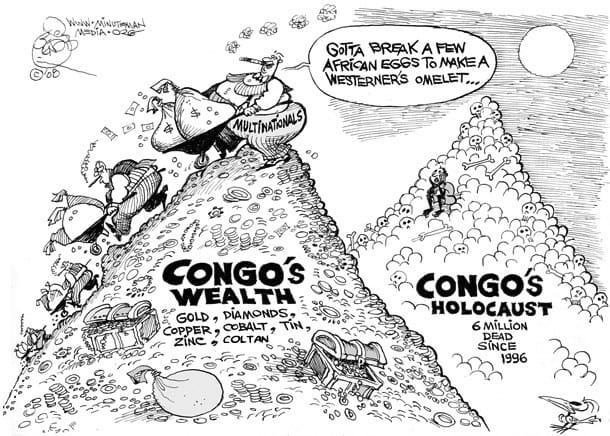
My contention is quite simple. The current conflict(s) in the Congo, the deliquescence of the state, the lack of infrastructures and "interconnectedness", are not merely unforeseen, pathological consequences of bad colonial and/or cold war policy gone awry. The current situation is a direct, calculated, and progressively manufactured result of a long-standing operation by Western nations to maintain a weak state in this vast mineral rich swath of land in the heart of Africa and perpetuate the systematic plunder of Congo's resources by various foreign interests, and their proxies in the local elite.
Seems far-fetched? Let us consider that, until proven otherwise, the Congo is a sovereign country, recognized as such by International law, the United Nations, and, in theory, every country on the planet. Yet despite that, over the past five decades, these very countries, (including supposed champions of the rule of law like The United States, Canada, Australia, the United Kingdom, Belgium, France and South Africa), have allowed their mining companies (like Banro, Freeport-McMoran, Anglo American, DeBeers, and others) to enter into odious contracts with corrupt elements of the leadership in Kinshasa, and worse, with murderous warlords, and near-genocidal militias, unhindered, and unpunished. Furthermore, several of these very countries and their corporations have provided the military, logistical and ideological support to the secessionist regimes in the 60's and 70's, Rwanda, Uganda, Angola, their proxy militias AND/OR their rival militias, thus destabilizing and creating a de facto partition of the country, and further guaranteeing maximized profits through cheap/slave/child labor under warlords. That is not happenstance, but cold, calculated, predatory business planning. In fact, one only has to examine the history of the ties between the Oppenheimer mining magnate family of South Africa - which founded, and finances, the Brenthurst foundation that one of the authors of There is No Congo, Greg Mills, leads - and the various regimes and rebellions we have seen in the Congo, to understand how integral these foreign corporate and state interests are to the conduct of ANY business in the Congo.
I contend that it is not so much that there is No Congo; nor is it that the Congo as a country is not possible. I contend that since 1959, it was deemed too much of a potential threat to several world and regional powers, and to the coffers of their corporate acolytes, to allow the rise of a strong, large, potential Brazil-type power, in the heart of Africa. And we can see why. Let us consider the Congo today. Despite being one of the poorest, badly-managed countries in the world, by virtue of its position and of its potential, the country is poised - should there be a great deal of change in leadership - to be a major guarantor of the development of a truly functional African continent, and African Union. As Herbst and Mills themselves justly point out, "the country is the region's vortex". Former South African President, Thabo Mbeki notes “There cannot be a new Africa without a new Congo.” President Barack Obama himself rightly notes “If Africa is to achieve its promise resolving the problem in the Congo will be critical.”
Over the years, despite all the adversity the Congo faces, and despite the desires they secretly harbor to see the Congo disintegrate to begin annexing its pieces, its neighbors in the region were forced to recognize its central and crucial position for the advent of further economic development for the entire continent. As a result, despite currently being, admittedly, an economic drag on all of them, the countries of Southern, Central, and Eastern Africa have all secured some form of regional economic/political supranational alliance with the Congo, whether through SADC, CEPGL, CEEAC or COMESA (all groups that constitute regional clusters in the building of the larger African Union).
There lies the issue for this country. Left to its own devices, a big, strong, unified Congo would be a powerful engine for the development, and the industrialization of the entire continent. Herbst and Mills, I believe justly state that "economically, the various outlying parts of Congo are better integrated with their neighbors than with the rest of the country." But that is not in Congo's disfavor. Whether in terms of its abundant precious and strategic minerals, the tremendous amount of renewable energy that could be generated by the Inga dam project on the Congo river, the natural gas in Lake Kivu or the geo-thermal potential of the volcanic mountains in the east, the second lung of our planet that is its rainforest, or the extraordinary - and exhaustively demonstrated - resilience of its people, the Congo has everything to be the central pillar around which Africa rises. Should the people of the Congo find a way to build the infrastructure to interconnect its outlying parts, the country would instantly become the key piece in regional development. That prospect has always unsettled many, whose interests might not be as well served should there be a strong government, a functioning army and police, and rule of law.
Herbst and Mills claim that "the very concept of a Congolese state has outlived its usefulness." When was it ever truly - and democratically - implemented, I ask? When, since 1885, have the affairs of the Congo ever truly been left to the Congolese people? See, I contend that the Congo has, intentionally, never even been given a fighting chance to live up to its potential. Its challenge since 1885 has been both an internal and external one. Under colonial rule, the people were voluntarily under-educated, and the infrastructure built was limited to basic transportation needs for minerals, and the comfort of colons. Under Mobutu, the regime, backed by Western powers, ruled with an iron fist, promoted corruption, allowed the deliquescence of the already meager infrastructure and mining industry, and progressively engineered a weakening of the state apparatus, the army and the police, in order to strengthen and impose Mobutu's personal rule, and better protect the mechanisms of the systematic plundering of the country's resources. The Congo today is the result of a systematic, documented, and fully reversible process of manufactured under-development, with roots in colonial and neo-colonial policies, but more importantly, in greed. Fomenting and perpetuating misery, turmoil, tribalism, destructive autocratic rule, and angling for the "Somalization" of the Congo, was more profitable to key greedy domestic elites and foreign groups, and more dependable for key foreign powers, than actually allowing this country to build the infrastructure it needed - and still needs - to succeed.
That is a far more accurate prism to consider the events that have befallen the Congo over the decades. It explains the secession of Katanga, the mineral rich southern province, only 7 days after independence in 1960, with the help of Belgium, the very colonial power the people of the entire country had just successfully sought to get rid of. It also explains the assassination of the first democratically elected Prime Minister, Patrice E. Lumumba, with, at the very least, the tacit backing of Belgium and the United States. It explains, for instance, the documented contacts between the Oppenheimer family of South Africa and Albert Kalonji Mulopwe, the "Emperor" of the secessionist South-Kasai, Moise Tshombe, leader of the Katanga secession, and rebel groups of more recent years. Finally, and most tragically, it explains how the Congo's neighbors - Rwanda, Uganda, and to some degree Angola, their proxy militias, their rival militias, and corrupt elements of the so-called leadership of the Congo and their militias, have been not only allowed by the international community, but backed and supported primarily by the United States and Britain:
- to systematically destroy, ransack and plunder an entire country, unhindered and unpunished;
- to brutally rape and sexually terrorize tens of thousands of women in front of their sons, fathers and husbands, unhindered and unpunished;
- to turn children into soldiers, unhindered and unpunished;
- and to cause the death of nearly 6 million people - a scale for another century - to this day, seamlessly, unhindered and unpunished.
All the above has been accomplished in blatant violation of every principle of International Law, and every principle of human decency, and in full view of the inadequately-led, inadequately-sized, ineffective, inept, overhyped, overpriced and overpaid so-called "largest United Nations peacekeeping force" (MONUC), and with logistical support from Western powers, and recently, the dreaded AFRICOM of the United States. Herbst and Mills argue that "the international community does not have the will or the resources to construct a functional Congo"? It seems more accurate to say that over the years, the international community has been - more or less intentionally - actively, and systematically undermining a functional Congo. It is for this reason that Antonio Guterres, High-commissioner of the UNCHR reminded us in his interview with the Financial Times, in January 2008, that we must not forget that “the international community has systematically looted the Congo” and that is a far different and, in my opinion, far more easily remediable problem.
The ultimate solution to the Congolese situation lies in investing on a key element that Herbst and Mills discount too quickly, and wrongly so: the Congolese people, its sense of citizenship, and its resilience. Through all the humiliations of colonialism and dictatorships, the scheming, the gaming, the profiteering, the raping, the oppression, the daily humiliations of poverty, the hunger, the injustice, the corruption, the tribalism and the morbid reality of living in a needlessly war-torn country, the Congolese people have emerged as quite the resilient people, AND quite the cohesive people; at least as cohesive as can be expected for any multi-cultural people, whether in the Congo, in South Africa, or in the United States. Congo may yet have "none of the things that make a nation-state", but I contend that you would be hard-pressed to find a Congolese citizen, rural or urban, who does not identify with the Congolese nation, and the "boundaries that the king of Belgium helped establish in 1885 ".
Yes, the lack of infrastructures makes the task to establish and solidify the regal functions of a strong, centralized state on the entire territory, unusually daunting. But the Congo is not the first, and will certainly not be the last, multi-cultural nation, that has to, in its formative years, struggle with translating their sense of national identity into stable, and accepted state institutions. It may be hard, but the argument that it is not worth thriving for, fighting for, and supporting, is simply untenable; especially coming from two scholars from the two countries in the world - the United States and South Africa - that symbolize the most (and I admire them for that) the possibility of overcoming tremendous and varying odds to build united and strong countries, that combine multi-cultural peoples, and effective, democratic states. Maybe the Congolese can learn from them, and Brazil, and India, and establish a strong, but truly federal state. When the Congo's affairs are left to the Congolese people, the possibilities are endless.
Now, that is definitely not to say it will be a cakewalk. The Congo we envision, thrive and advocate for is possible, but it will entail a great deal of work and investment from the Congolese people. Those in the “learned class” – economists, agronomists, engineers, teachers, doctors, etc - that have managed to maintain their integrity by not partaking in the plunder of the Congo, will have to outgrow this sense of cynicism, hopelessness and apathy that has seeped into their consciousness due to years of despair and lack of prospects for change, and roll-up their sleeves. The Congolese will need to revitalize the education sector, so as to ensure that the coming generations have access to the knowledge they need to continue the task of rebuilding their country. They will also need to organize education/training initiatives for urban and rural adults, in various fields, among which – and most importantly – sustainable agriculture, construction, urbanization, sanitation, and salubrity. They will need to reinforce notions of civics, citizenship, human rights, civil and civic rights, law and order, and respect for women, which years of oppression and mis-education, of Leopoldism, colonialism, Mobutism and other -isms have caused to somewhat crumble away in the general consciousness. Finally, on a national level, they will need to seek worthy partners to do all the above, and also begin the work of reconnecting the Congo to the main grids of modern technology, starting with the electrification of the country, through the rehabilitation and completion of the Inga hydroelectric complex. The task is not complex for the Congolese people; it is simply tedious. The prescriptions we put forth imply a laborious, time-consuming but necessary grassroots work, that needs to start yesterday, but is absolutely achievable. And given a true opportunity, I believe the Congolese people are up to the task.
So, instead of giving up on the Congo, and dismissing it as an irredeemable failure, I say let the Congo and its people truly amaze you. Give the Congo a fighting chance. It is quite simple, really. Intel, Nokia, Dell, T-Mobile, IBM, Banro, Freeport-McMoran, Anglo American, Chevron, Tullow and all the other companies identified in the Financial Times and United Nations Reports from 2001 – 2003, that romp through Congo for coltan, cassiterite, tin cobalt, gold, diamonds, oil, etc, should cease and desist from buying minerals illegally from warlords, from neighboring countries that have looted our resources, or through odious or illegal contracts. By all means, invest in Congo, but be deliberate and intentional about doing it through the proper channels. Stop financing and arming warlords. All people of goodwill should discourage the Congo's neighbors from meddling in its affairs and support and finance education and healthcare institutions. Support local institutions, and help the civil society hold the central government, the provincial governments and the security forces truly accountable.
And finally this time, this time, help the Congolese ensure that they conduct truly free, fair, transparent and democratic elections in 2011. The International Crisis Group's 2007 report "Congo: Consolidating the Peace", shows quite clearly that the last time around, the International community was more concerned about access to lucrative mining contracts as opposed to a democratic process that would reflect the interests of the people. Let us all thrive to prevent a repetition of that. The Congolese have an imperfect constitution, with imperfect prescriptions, and imperfect institutions, but they are all theirs to perfect. Let the Congolese people choose its own leaders, and manage its own territory. Give them the chance they have never had: to demonstrate their capacity to be a viable nation, and establish for themselves a state that helps their country live up to its full potential. Is that really a concept that has outlived its usefulness? I dare think not.
Ali Mamina is a Congolese Political Sciences graduate with an international focus from Earlham College in Richmond, Indiana, and an adviser to The Friends of the Congo
The FOTC was established at the behest of Congolese human rights and grassroots institutions in 2004, to work together to bring about peaceful and lasting change in the Democratic Republic of Congo.
Author can be contacted at this address (FOTC), a 501 (c) 3 tax-exempt advocacy organization based in Washington, DC.
Tags:




 Posts
Posts

